
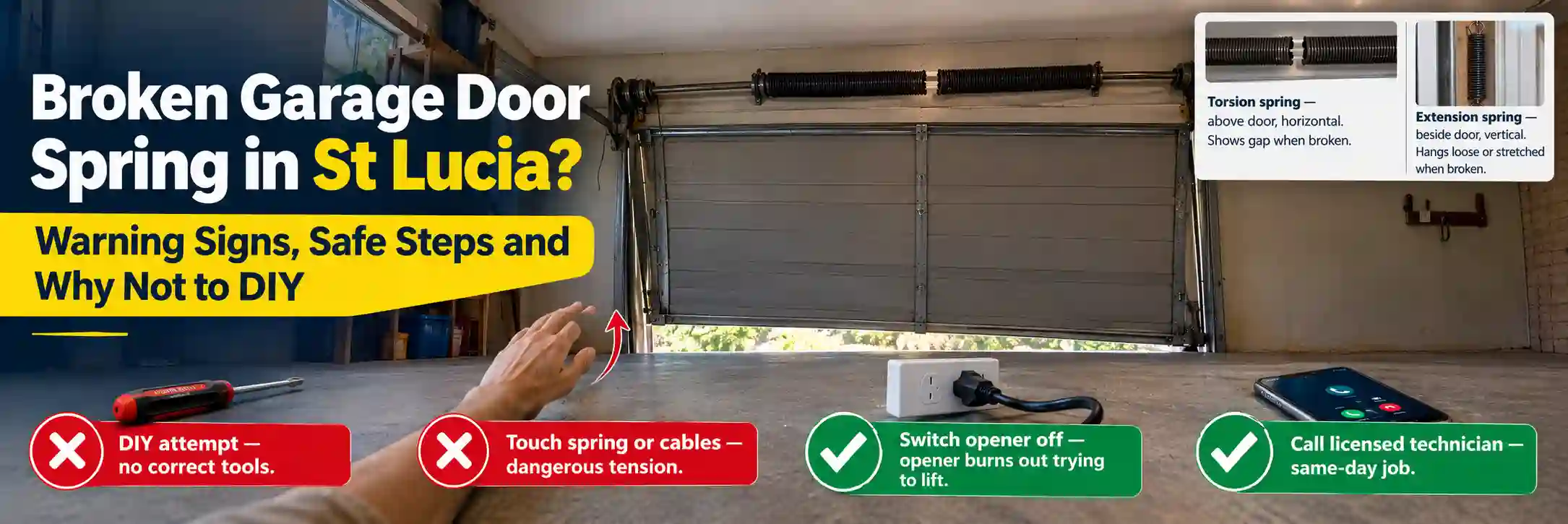
You’re in the kitchen when a sharp crack echoes from the garage, loud enough to make you jump. Nothing seems out of place until you try the door, and it won’t budge.
That bang is the classic sign of a broken garage door spring, the part that carries most of your door’s weight. It’s one of the most common garage door failures, and one of the few you should never try to fix yourself.
This guide covers the warning signs, what to do straight away, and why professional replacement is the only safe option.
What Does a Garage Door Spring Actually Do?
A garage door is heavy, and the opener was never built to lift it alone. Springs counterbalance the weight, so the door feels almost weightless when it moves.
Each time the door opens and closes, the spring takes on and gives up tension. That repeated stress is why every spring eventually fails.
Torsion or Extension? Know Your Spring Type
Most Australian homes use one of two spring systems, and a quick look tells you which.
- Torsion springs sit horizontally above the door opening and twist to lift the door. They’re common on sectional doors and last longer, often 15,000 to 20,000 cycles.
- Extension springs run along the sides of the door and stretch as it opens. They’re common on tilt doors and typically last around 10,000 to 15,000 cycles.
Roller doors hide a spring inside the barrel above the opening.
St Lucia’s older homes with original tilt doors are likely to have extension springs, which makes them worth a closer look.
Extension springs should have safety cables running through them. If one snaps without a cable, it can whip across the garage with real force.
Signs Your Garage Door Spring Is Broken
Some signs are impossible to miss. Others are easy to explain away. Look for these:
A Loud Bang From the Garage
A snapping sound like a gunshot is the most obvious clue. If you heard one, even hours ago, check the door before using it.
A Visible Gap in the Spring
Stand back and look above the door without touching anything. A torsion spring that has snapped shows a clear gap between the coils. An extension spring may hang loose or look stretched.
A Heavy Door or a Door That Barely Lifts
Without spring help, the door feels like dead weight. The opener may hum, strain, or lift the door only a few centimetres before stopping.
A Crooked or Uneven Door
On a two-spring system, one broken spring can leave one side rising faster than the other. The door twists as it moves and may jam.
Loose or Hanging Cables
When a spring lets go, the lift cables often go slack or slip off their drums. Slack cables mean the spring system is no longer doing its job.
A Door That Slams Shut
A door that drops quickly or won’t stay open has lost its counterbalance. That’s a crushing risk for anyone or anything underneath.
What a Broken Spring Looks Like on Different Doors
- Sectional doors: a gap in the spring above the door, slack cables and a heavy, crooked lift
- Roller doors: the door feels heavy, struggles to roll up or stops partway, with the spring hidden inside the barrel
- Tilt doors: a stretched or loose spring at the side, a door that drops or won’t stay up, and an opener that strains
- Roller door springs can’t be inspected by eye, so a technician’s diagnosis is even more important.
Early Warning Signs Before the Spring Snaps
Springs often give hints before they fail. Watch for these:
- The door feels heavier or moves more slowly than it used to
- New grinding, squeaking or straining noises
- Jerky or uneven movement as the door opens
- Visible rust, stretching or wear on the spring
- A spring that’s well past its expected cycle life
Springs are rated by cycles, where one cycle is a full open and close. A household using the door several times a day can use up those cycles within years, not decades.
Expert tip: If your springs are old and one breaks, ask your technician about replacing both. The second spring has done the same work and is often close behind.
What Causes a Garage Door Spring to Break?
Springs don’t fail for no reason. The usual causes are:
- Cycle wear: every open and close uses up a little of the spring’s life
- Rust and humidity: moisture weakens the metal, and Brisbane’s humid summers don’t help
- Poor maintenance: dry, neglected springs wear faster
- Low-cycle springs: builder-grade doors often come with springs rated for fewer cycles
- An unbalanced door: extra weight from damage or heavy add-ons strains the springs
What to Do Right Now If Your Spring Breaks
- Stop using the door. Don’t press the remote or wall button, because the opener can burn out trying to lift it.
- Keep clear of the door and the spring. Don’t stand or park underneath it.
- Don’t touch the spring, cables or winding hardware. They can still hold dangerous tension.
- Resist forcing the door open. A heavy door can drop suddenly and trap hands or crush a vehicle.
- Call a licensed technician and mention what you heard and saw.
If the door is stuck closed with your car inside, wait for the technician. If it’s stuck open, keep people clear and treat it as urgent, since an open garage is a security risk.
Is a Broken Garage Door Spring an Emergency?
It’s urgent, but it’s not a life-threatening emergency as long as nobody tries to use or repair the door. The real risk comes from carrying on as if nothing has happened.
Treat it as same-day work if your car is trapped inside, the door is stuck open, or the garage connects directly to your home.
Why You Should Never Replace a Garage Door Spring Yourself
It looks simple on a video, but the job is one of the most dangerous a homeowner can attempt. A spring under tension stores enough energy to cause serious injury in an instant.
- Stored energy: winding bars can slip, and a spring can release violently.
- Heavy falling door: a miscalibrated spring leaves the door unbalanced and ready to drop.
- Cable whip: cables under tension can slip off their drums and lash out.
- Wrong spring: the wire size, length and rating must match your door’s weight exactly.
- Specialist tools: proper winding bars and clamps are essential, and a screwdriver is not a substitute.
- If your door has two springs and one breaks, the other still holds dangerous tension.
Skipping DIY isn’t about being cautious, it’s about being sensible. A professional carries the right tools, insurance and experience, and does the job in a fraction of the time.
What a Technician Does During Spring Replacement
- Secures the door so it can’t move or fall.
- Measures the old spring and matches the right replacement for your door’s weight.
- Fits the new spring and winds it to the correct tension.
- Checks the cables, rollers, drums and brackets for wear.
- Balances the door and tests it through several full cycles.
A straightforward replacement usually takes an hour or two. A local St Lucia technician often carries common springs and parts, so many jobs are finished in one visit.
Ask about high-cycle springs. They cost a little more but are rated to last longer, which suits busy households.
Can You Still Use the Door With a Broken Spring?
Technically the door might move, but it shouldn’t be used. Operating a door with a broken spring risks injury, a dropped door and a burnt-out opener.
Each cycle also loads the tracks, cables and panels in ways they weren’t designed for. A single spring repair can quickly turn into a larger one.
How to Help Your Springs Last Longer
- Book a professional service once a year so springs and cables are inspected
- Have springs lubricated by a technician as part of a service
- Keep the door balanced and the rollers and tracks in good condition
- Don’t ignore new noises, slow movement or a heavier feel
- Replace old springs before they fail, especially on busy doors
Expert tip: Note the date your springs were last replaced, and listen to the door every time you use it. A change in sound is often the first sign a spring is tiring.
Conclusion
A broken garage door spring sounds dramatic because it is. A loud bang, a heavy door and a visible gap are all signs the part holding up your door has let go.
The safest response is simple: stop using the door, keep clear, and leave the repair to a licensed technician. Springs store far more energy than most people realise, and mistakes happen in a split second.
For St Lucia homes with older tilt doors, it’s worth checking that extension springs have safety cables, and noting the age of your springs so replacement can be planned, not rushed.
Spotting the early signs, servicing the door yearly and respecting the danger of tension will keep your garage door working, and keep you safe.