
The third callout this year, another part on the quote, and a nagging question: do you keep fixing it, or is it time to start fresh?
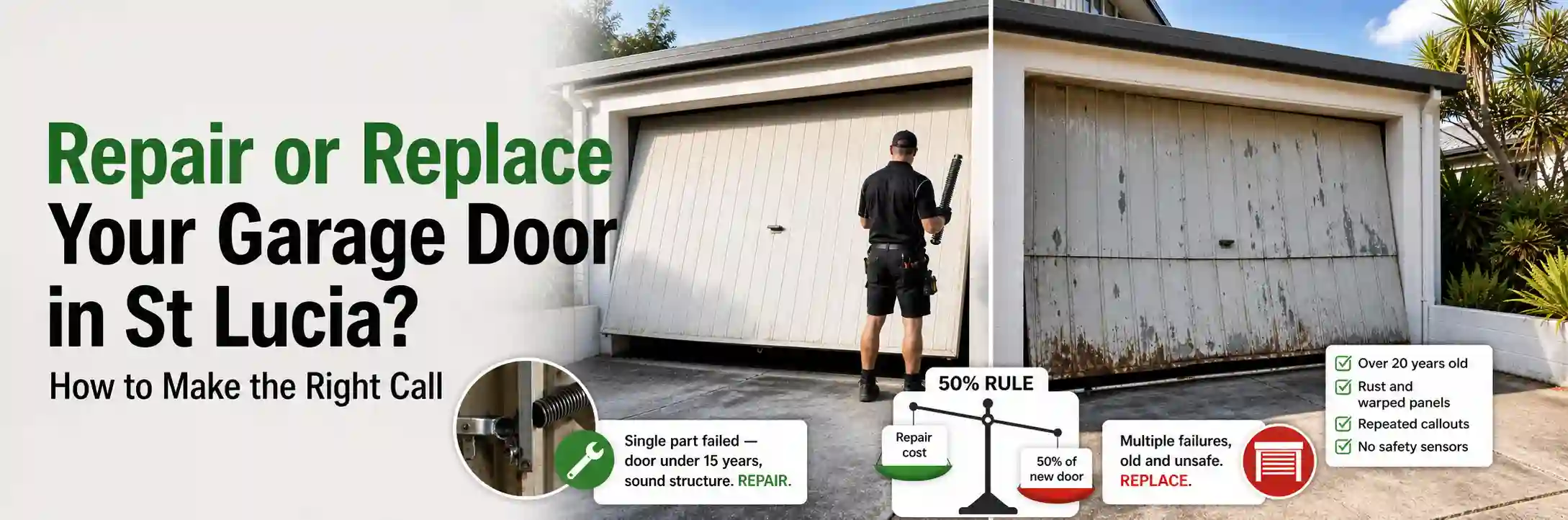
Repair your garage door when the problem is a single part and the door is otherwise sound. Replace it when the door is old, badly damaged, or breaking down in several places at once.
The detail is in the grey area between those two, so this guide gives you a simple way to decide, with St Lucia’s mix of older tilt doors and newer roller and sectional doors in mind.
When Is It Worth Repairing a Garage Door?
Repair makes sense when the fault is isolated and the rest of the door is in good shape. Typical examples include:
- A broken spring or snapped cable on an otherwise solid door
- Worn rollers, hinges or weather seals
- A faulty remote, sensor or opener on a healthy door
- A single damaged panel that can be replaced individually
- A track that’s been knocked but can be straightened or swapped
A good rule of thumb: if the problem is one component and the door is under about 15 years old, repair is usually the smarter move.
Many quality doors last 20 to 30 years with proper care, and openers typically last 10 to 15 years. So a worn opener doesn’t mean the whole door is finished.
When Should You Replace Your Garage Door?
Replacement becomes the better call when repairs stop solving the problem. Watch for these signs:
The Door Is Old and Wearing Out
Doors beyond 20 years often have rust, tired panels and worn hardware all at once. Fixing one part just exposes the next.
The Damage Is Structural
Bent frames, warped panels, cracked sections or a door that’s been hit hard are signs the structure itself has been compromised. A twisted door puts constant strain on the tracks, springs and opener.
Repairs Keep Piling Up
If you’re calling a technician every few months, the running total adds up quickly. Several components failing close together usually means the whole system is at the end of its life.
Safety Features Are Missing
Older doors and openers may lack modern features like auto-reverse and safety sensors. If your system predates them, an upgrade is a safety decision, not just a style one.
It Doesn’t Seal, Insulate or Secure Properly
Gaps at the sides or bottom let in dust, pests and water, and make it easier for someone to force the door. A well-fitting new door can fix all three.
Use the 50 Percent Rule to Decide
Here’s a simple test technicians use. If the cost of the repair is more than half the cost of a new door, replacement is usually the better value.
Add the door’s age, the number of recent repairs and how safe it feels to use, and the answer usually becomes clear.
Remember the rule is a guide, not a law, since a safe, reliable door is worth more than a cheap patch.
Expert tip: Ask your technician for both a repair quote and a replacement quote on the same visit. Seeing the two side by side makes the decision far easier, and a good tradie will tell you honestly which one makes sense.
Repair or Replace? A Quick Comparison
Use this table as a quick sense check. Your own door may sit somewhere in between.
| Situation | Better choice |
| Broken spring on a door under 15 years old | Repair |
| Worn remote, sensor or opener | Repair |
| One damaged panel, door otherwise sound | Repair |
| Door over 20 years old with rust and wear | Replace |
| Several panels damaged or door warped | Replace |
| Repeated breakdowns across different parts | Replace |
How Long Do Garage Door Parts Usually Last?
Knowing typical lifespans helps you judge whether a part is simply due, or whether the whole door is ageing out.
- Door: often 20 to 30 years with good care
- Opener: typically 10 to 15 years
- Rollers: around 7 to 15 years, depending on the material
- Springs: rated for a set number of open and close cycles, often 10,000 to 20,000
A household that opens the door several times a day uses those cycles up much faster than one that rarely does.
Expert tip: Keep a note of the date your door and opener were installed, and when each part was last replaced. That history makes every future repair or replace decision much easier.
What Changes for Older Tilt Doors in St Lucia?
Older homes around St Lucia often still have the original tilt door. A tilt door is a single solid panel that pivots up and out on side-mounted arms or springs.
Many of these doors are still worth keeping. New springs, hinges and a retrofitted opener can give an old tilt door years of extra life, especially if the panel is straight and the frame is sound.
Replacement makes sense when the panel has rusted, warped or been damaged, or when you want a quieter, safer door. Canopy-style tilt doors swing outwards, so they need clear space in front of the garage. If that’s a problem, a roller or sliding-style door can be a better fit.
Expert tip: If you’re replacing a tilt door, check the headroom and the space in front of the garage before choosing a new door type. Switching to a roller or sectional door isn’t always a simple swap, because each type uses a different track and mechanism.
Which Replacement Door Suits Your Garage?
- Roller doors: compact, simple and good where headroom is tight, so they suit many older garages.
- Sectional doors: slide up along the ceiling, work well with insulated panels and can be very quiet, especially under a bedroom.
- Tilt doors: a single panel with a classic look, but heavier and less flexible, and some styles need clear space out front.
A technician can measure your garage and recommend the best fit for your headroom, side room and budget.
Don’t Forget the Opener
A new door doesn’t always need a new opener, and a new opener doesn’t always mean a new door. Openers usually last 10 to 15 years, so one that’s near the end of its life can be swapped separately.
If you’re replacing the door, it’s worth checking that the opener suits the new door’s weight and type. A mismatch can wear out either one faster.
The Hidden Cost of Patching Up an Old Door
Repairs can feel cheaper in the moment, but an ageing door has a way of failing again. Each breakdown can leave you stuck at the worst time, with the car trapped inside or the garage left open.
Worn parts also pass their stress on to the rest of the system. A tired door makes the opener work harder, and a weak spring wears out the cables and rollers around it.
Replacing a door at the right time is often cheaper than paying for a string of emergency callouts.
Think About Your Home or Rental Property
The garage door is one of the biggest things you see from the street, so it shapes first impressions. A tired, dented door can drag down an otherwise well-kept St Lucia home.
If you own an investment property, reliability matters even more. A door that works every time means fewer urgent calls from tenants and fewer emergency callouts for you.
What a Technician Looks at Before Giving Advice
An honest assessment goes beyond the one broken part. A good technician will check:
- The door’s age, material and overall condition
- The springs, cables, rollers and tracks for wear
- Whether replacement parts are still easy to get
- How the opener performs and whether it suits the door
- Safety features such as sensors and auto-reverse
From there, they can explain your options clearly, with the pros and cons of each. You should never feel pushed toward a new door when a straightforward repair would do the job.
A Simple Checklist Before You Decide
Run through these questions. The more you answer yes to, the stronger the case for replacement:
- Is the door more than 20 years old?
- Would the repair cost more than half the price of a new door?
- Have you had several repairs in the past year or two?
- Are the panels bent, rusted or badly damaged?
- Does the door lack safety sensors or auto-reverse?
- Is it noisy, shaky or hard to balance even after servicing?
A single yes may still mean a repair is fine. Three or more suggest it’s time to plan a replacement.
Conclusion
Deciding between repairing and replacing a garage door comes down to a few honest questions. How old is the door, how bad is the damage, how often has it broken down, and does it still feel safe to use?
Repair suits a sound door with one failed part. Replacement suits an old, damaged or unreliable door that keeps asking for attention.
For many St Lucia homes, especially those with original tilt doors, the answer may even be a bit of both: repair now, plan the upgrade later.
Whatever you choose, a decision made calmly and with the full picture beats one made in a panic when the door finally stops working.