
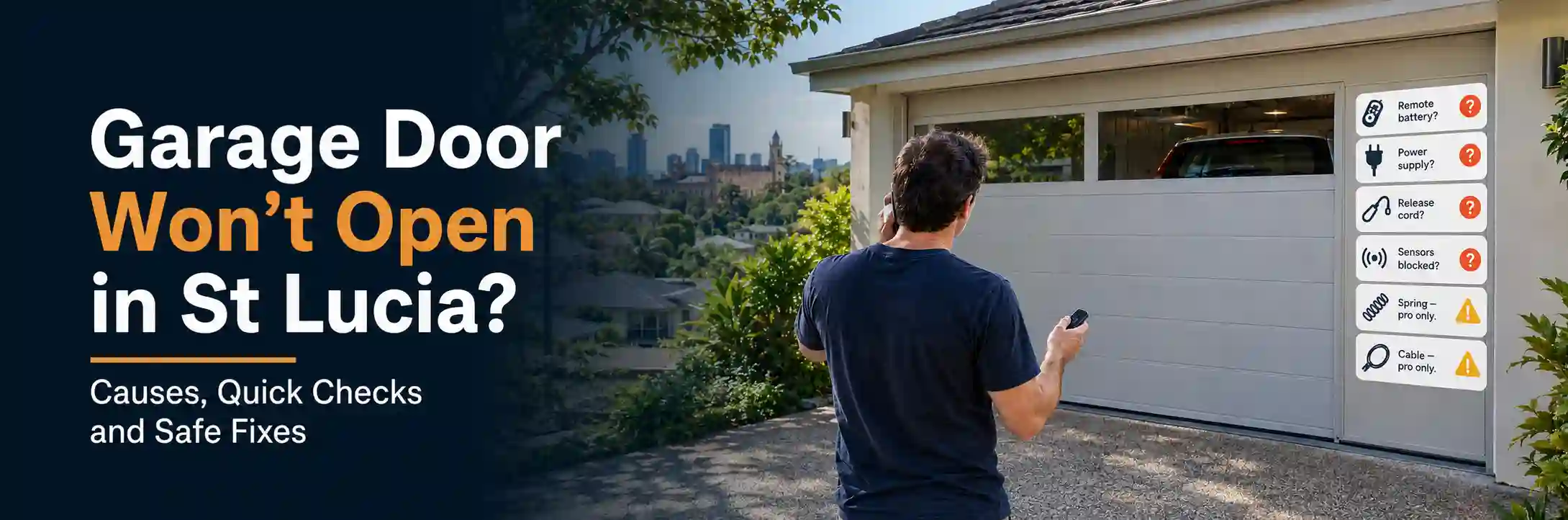
You press the remote, hear a click or a hum, and nothing moves. The car is stuck inside, the morning is slipping away, and you’re not sure whether to grab a screwdriver or a phone.
A garage door won’t open most often because of a dead remote battery, no power to the opener, a disconnected release cord, blocked safety sensors, or a broken spring or cable. The first four are quick checks you can do yourself. The last two need a licensed technician.
This guide works through each cause in the order a tradie would check it, so you can find the problem quickly and know exactly when to stop.
Why Your Garage Door Won’t Open at a Glance
| What you notice | Likely cause | DIY or pro? |
| Nothing happens, no light or sound | No power or opener fault | Check power, then pro |
| Wall button works, remote doesn’t | Remote battery or programming | DIY |
| Motor runs, door won’t move | Release cord pulled or broken spring | Check cord, then pro |
| Door reverses or won’t close | Sensors blocked or misaligned | DIY |
| Loud bang, door feels heavy | Broken spring | Pro only |
| Door jammed or crooked | Off track or damaged cable | Pro only |
Start With the Simple Checks
Before you assume the worst, spend two minutes on the basics. Most stuck-door callouts end with one of these.
Check the Remote and Wall Button
Press the wall button inside the garage. If it opens the door but the remote doesn’t, the opener is fine and the remote is the problem.
Swap in a fresh battery first. If that doesn’t help, the remote may need reprogramming to the opener, or it may simply have worn out after years of use.
Expert tip: Test every remote you own, including the one in the car. If only one fails, it’s the remote. If none work, look at the opener or the power.
Check the Power Supply
If there’s no light, sound or click when you press the button, the opener probably has no power. Summer storms around Brisbane can trip the safety switch or cut the power for a while.
Check the opener is still plugged in, then look at the safety switch in your meter box. Plug a lamp into the same power point to confirm it’s live.
Check for a Lock or Holiday Mode
Many openers have a lock feature on the wall panel that switches off the remotes. Some also have a holiday mode. Button combinations differ between brands, so check your opener’s manual.
Older tilt doors and some roller doors also have a manual lock on the door itself. If it’s engaged, the opener can’t move the door.
When the Motor Runs but the Door Won’t Move
This one catches plenty of people out. You press the button, the opener whirs or hums, but the door stays exactly where it is.
The Release Cord May Have Been Pulled
The red emergency release cord disconnects the door from the opener so you can lift it by hand. If someone pulled it during a power outage, or a kid gave it a tug, the opener will run without moving the door.
With the door fully closed, reconnect it by following the steps in your opener’s manual. On most models that means pulling the cord toward the motor until the trolley clicks back into place.
Only use the release cord when the door is fully closed. If the door is stuck partway open, leave the cord alone, because the door can drop without warning.
A Broken Spring Is the Next Suspect
If the cord is connected and the opener still strains, hums or lifts the door a few centimetres before stopping, suspect the spring.
Springs do the heavy lifting. A garage door can weigh well over 60 kilograms, and the opener was never designed to carry that load alone.
Common signs of a broken spring include a loud bang from the garage, a door that feels very heavy, a visible gap in the spring coil, or a door that sits crooked.
Don’t try to lift a door with a broken spring, and never attempt a spring repair yourself. The tension involved can cause serious injury.
When the Door Stops Partway or Moves Roughly
Inspect the Safety Sensors
Two small sensors sit near the bottom of the tracks and send an invisible beam across the doorway. If a bag, a bike wheel or a spiderweb breaks that beam, the door may stop, reverse or refuse to move.
Flashing lights on the opener are a common clue. Wipe both lenses with a soft cloth, clear anything in the way, and make sure the sensors point straight at each other. A knocked bracket is a frequent culprit.
Look Over the Tracks and Rollers
Check both tracks for dents, loose bolts, debris or a roller that has jumped out. A door that rises a little and then jams is often catching on something.
Wipe the tracks clean with a dry cloth. If the door looks crooked or off its track, don’t force it. Pushing on can bend the track and damage the opener.
Expert tip: Keep tracks clean and dry rather than greasy. Use a silicone-based spray on rollers and hinges instead. Grease on the tracks just collects dust and grit.
Watch for Frayed or Slack Cables
Steel cables run from the bottom corners of a sectional door up to the spring system. If one looks frayed, loose or has slipped off its drum, leave it alone. These cables are under heavy tension and need a technician.
Tilt, Roller and Sectional Doors Fail Differently
The type of door you have changes what’s likely going wrong. St Lucia’s older homes often still have tilt doors, while newer townhouses tend to have roller or sectional doors.
- Tilt doors: worn pivot arms, tired springs and stiff hinges are common, especially on doors decades old.
- Roller doors: the spring sits inside the barrel, so a door that jams is often off its guides or has a worn drive.
- Sectional doors: cables, rollers and torsion springs do the work, so a bang, a crooked lift or a hanging cable points to a pro job.
If you’re fitting a modern opener to an older tilt door, the door needs to be balanced first. A badly balanced door will make even a new opener struggle.
How Do You Open a Garage Door Manually?
If the power is out or the opener has failed, you can usually lift the door by hand once it’s disconnected from the opener. Here’s the safe way to do it.
- Make sure the door is fully closed.
- Pull the red release cord straight down until you feel the trolley disconnect.
- Lift the door from the centre or the handles, slowly and with both hands.
- Keep a firm grip the whole way, then lower it gently when you’re finished.
Some doors also have an outside key release, which lets you disconnect the opener from the street side.
If the door feels extremely heavy, won’t stay up, or you heard a bang beforehand, stop. That points to a broken spring, and lifting the door can be dangerous.
When to Call a Garage Door Technician
Some problems are simply not worth the risk. Call a licensed technician straight away if you notice any of these:
- A loud bang followed by a heavy or stuck door
- A visible gap in the spring or a frayed cable
- A door that is crooked, jammed or off its track
- An opener that hums or grinds but doesn’t move the door
- A burning smell, smoke or a loud pop from the opener
- Problems that keep coming back after the simple checks
A local St Lucia technician can diagnose the fault on the spot and, in most cases, carry the parts needed to fix it in a single visit. That matters when your car is stuck inside or the door is sitting open overnight.
If the door is stuck open, treat it as urgent. Keep people and pets clear and get it secured as soon as you can.
How to Stop It Happening Again
- Most garage door breakdowns build up slowly, and a few habits catch them early.
- Test the release cord and manual lift twice a year, with the door closed
- Replace remote batteries before they die, not after
- Wipe the sensor lenses and clear the floor area around them
- Listen for new grinding, scraping or squealing sounds
- Book a professional service once a year, ideally before storm season
Expert tip: If the door has become noisier, slower or heavier over the past few months, don’t wait for it to fail. Those are early warnings from the springs, rollers or opener, and a service now is far cheaper than an emergency later.
Conclusion
A garage door that won’t open feels like a crisis, but the cause is often simple. A flat battery, a tripped safety switch, a disconnected release cord or a blocked sensor can explain plenty of stuck doors across St Lucia.
Work through those checks in order, and you’ll often have the door moving again in minutes. If the signs point to a spring, cable or track problem, stop and leave it to the professionals.
Whether your home has an older tilt door or a modern sectional, the same rule applies. Knowing what’s safe to check and what isn’t protects both your door and you.